The Efficiency of Discarding Ethics
Nirmal Purja didn't just climb fourteen peaks; he optimized a logistical supply chain that happens to involve oxygen-starved humans. The old guard of climbing used to drone on about the 'spirit of the mountains' and 'fair means,' which is essentially code for being slow and statistically likely to die in a crevasse without a GoPro to capture the moment. We have moved past such primitive notions. Why spend decades honing a craft when you can simply hire a small army to fix ropes, carry your pride, and ensure you reach the summit in time for a brand deal activation?
Setting a record used to imply a mastery of skill, but in the modern 'Validation-Industrial Complex,' it mostly implies a mastery of project management. The allegations of shortcutting—using helicopters to bypass the boring parts of the mountain or claiming records on technicalities—are not scandals. They are simply high-altitude corporate restructuring. If the goal is the data point at the end, the physical act of climbing is just a tedious hurdle between you and a verified checkmark.
The Death Zone as a Content Studio
There is something deeply moving about seeing a queue of two hundred people standing in the freezing cold at 8,000 meters, all waiting for their thirty seconds of solo footage. It’s exactly like the DMV, except the oxygen is thinner and the fees are slightly higher—roughly $60,000 to $100,000 per person. We’ve successfully democratized extreme risk by turning it into a luxury service package. The mountains haven't changed, but our ability to ignore their gravity in favor of our follower count has reached peak efficiency.
Achievement is now a commodity that can be purchased, packaged, and distributed via satellite link. We are witnessing the birth of the 'Professional Summiter,' a creature that exists not to explore the limits of the human psyche, but to explore the limits of a battery pack in sub-zero temperatures. The psychological shift is complete: the mountain is no longer an adversary or a teacher; it is a stage prop. And like any good prop, it needs to be managed, manipulated, and occasionally lied about to ensure the lighting is just right.
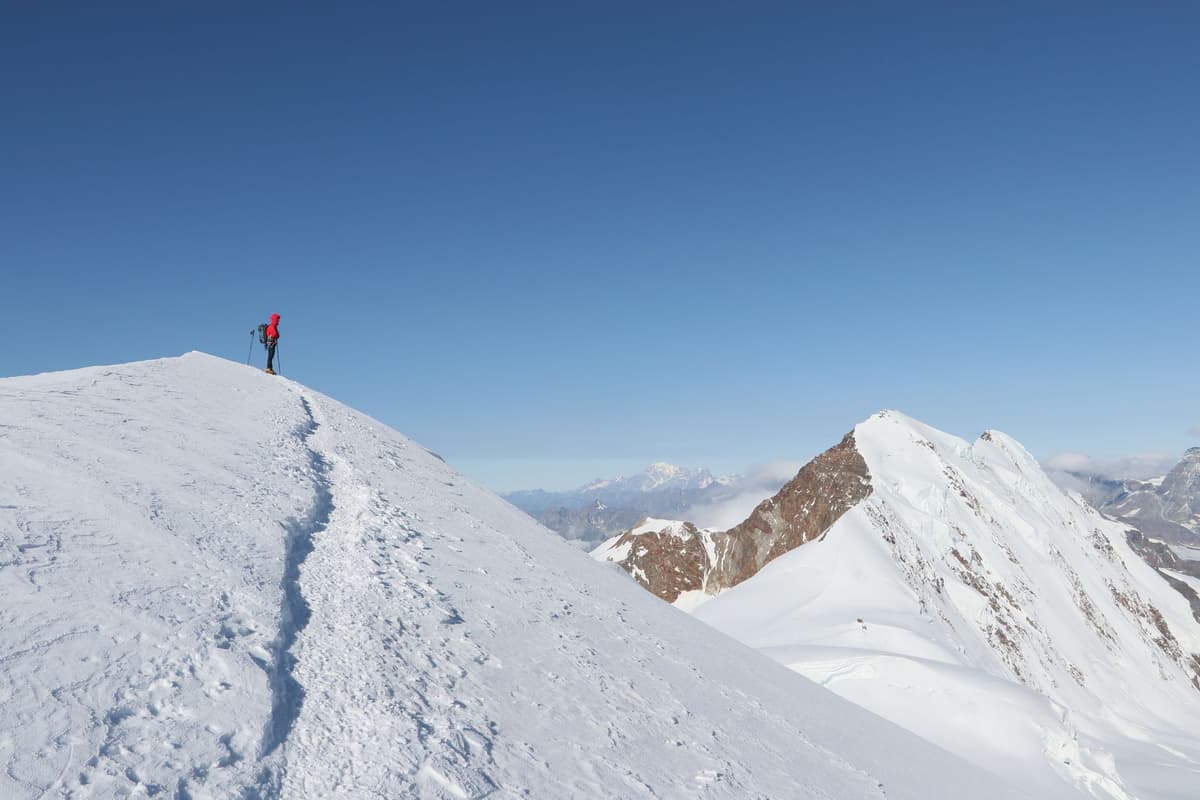
Photo by Ezmari Nabizadeh on Pexels
Risk Assessment for the Algorithmic Age
Risk used to be a private conversation between a climber and the void. Now, it’s a public-facing asset. If you take a massive risk and survive, you’re a visionary; if you take a massive risk and die, you’re a cautionary tale with a high engagement rate. The 'Summit Fever' of the past was driven by a desperate, internal need to stand on top. Today’s fever is much more clinical. It’s the cold, hard calculation that a summit record is worth more than a few toes, a clean reputation, or the safety of the Sherpas who are actually doing the heavy lifting.
When Purja’s 'Project Possible' smashed records in 2019, it proved that the human spirit is truly indomable—provided the human spirit has access to private helicopters and a very specific interpretation of 'climbing.' We have successfully redefined 'extreme' to mean 'extremely well-funded.' The internal transformation that mountaineering used to promise has been replaced by a much more reliable external transformation: the transition from a person with a hobby to a person with a personal brand. It’s much more efficient this way. You don’t have to reflect on your life if you’re too busy checking your mentions.
What This Actually Means
We have finally reached the logical conclusion of the meritocracy: if you can pay for the result, you deserve the status of having achieved it. The controversy surrounding Purja and the broader elite climbing scene isn't about whether people are 'cheating.' It’s about the fact that we’ve collectively decided that the 'how' is irrelevant as long as the 'what' looks good on a slide deck. We have commodified the sublime, and in doing so, we've made the world’s highest peaks about as spiritually significant as a treadmill at a high-end gym.
The psychological definition of achievement has shifted from an internal state of being to an external state of data. We don't want to be better; we want to have more. More peaks, more speed, more records, more noise. The mountains used to be a place to escape the hollow vanity of the world below, but we’ve successfully dragged that vanity up to 8,848 meters and planted a flag in it. It’s a remarkable feat of engineering, really. We’ve made the clouds as shallow as a puddle.
Quick Answers
Is 'fair means' climbing officially dead?
It’s not dead; it’s just poorly funded and lacks a compelling social media strategy.
Do the allegations of ethical shortcuts matter?
Only if they affect the sponsorship contracts or the Netflix sequel's production value.
Why are people still surprised by this behavior?
Because we still cling to the romantic delusion that high altitudes somehow make people less susceptible to being basic attention-seekers.
What is the future of elite mountaineering?
Probably a subscription-based service where you can VR-climb K2 from your couch while a robot in Pakistan actually does the work for you.**