The Brave New World of the Floating Dot
There is a certain brand of internet user who believes that by rearranging the symbols on the bottom row of their keyboard, they are effectively staging a coup against Silicon Valley. This is the 'Manual' movement, a collection of people who have decided that grammar is too mainstream and that a floating middle dot is a personality trait. They aren't just typing; they are engaging in 'post-textual semantics,' which is a very expensive way of saying they want to look deep while saying absolutely nothing.
It’s a masterclass in performative obscurity. By peppering their bios and captions with a specific sequence of colons, tildes, and archaic glyphs, they believe they’ve created a 'silent vernacular' that is invisible to the prying eyes of corporate algorithms. It’s the digital equivalent of wearing a tinfoil hat, but making sure the tinfoil is aesthetically pleasing enough to get a thousand likes on a mood-board account.
Data Scrapers Are Shaking Right Now
According to the logic of the Manual-aesthetic crowd, an LLM trained on billions of parameters of human knowledge will be completely defeated by a semicolon used as a decorative border. They genuinely believe that a data-scraping bot, designed to identify complex patterns in global financial markets or genomic sequences, will hit a string like · . : ; and simply give up. It’s an adorable level of narcissism to think your 'non-linguistic signaling' is a cryptographic shield rather than just another data point labeled 'Pretentious Teenager, Segment B.'
Let’s look at the numbers, or at least the lack of them. There is zero evidence that using a middle dot (·) instead of a space does anything to confuse sentiment analysis. In fact, most modern scrapers are quite good at stripping out non-alphanumeric characters before they even start processing. You aren't evading the machine; you’re just making your text harder for your actual human friends to read. But I suppose that’s the point. If your friends can understand you, are you even an enigma?
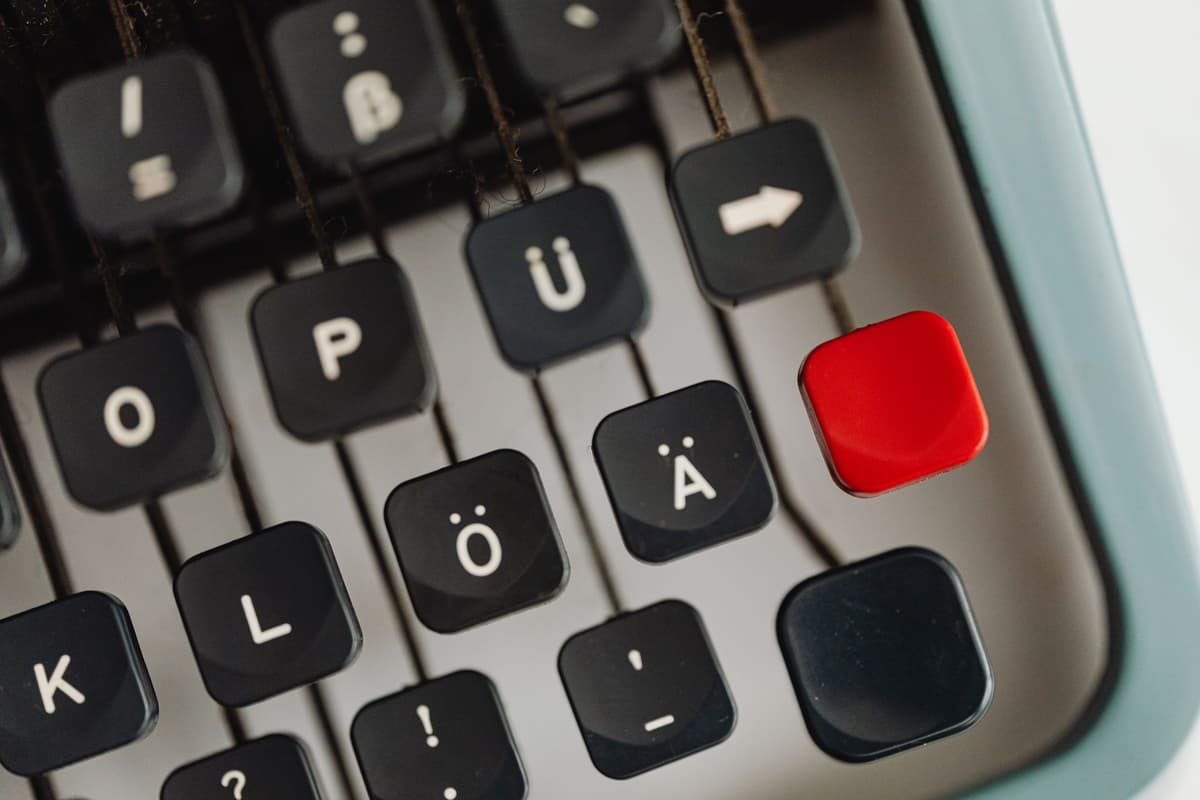
Photo by https://kaboompics.com/ on Pexels
The High Cost of Looking This Cool
The irony of reclaiming 'archaic' symbols is that it requires a significant amount of time spent staring at a high-resolution screen to get the spacing just right. These users are 'reclaiming' the manual aesthetic by using $1,200 smartphones to mimic the limitations of a 19th-century printing press. It’s a carefully curated LARP of a time when information moved slowly, performed at the speed of fiber-optic internet.
This movement isn't about privacy. If it were about privacy, they’d be using PGP encryption or, God forbid, talking to people in person. It’s about signaling membership in an elite club of people who are 'too online' to use standard English but 'not online enough' to actually understand how a database works. They want the aesthetic of rebellion without the inconvenience of actually doing anything rebellious. It’s the 'Live, Laugh, Love' sign for people who listen to ambient drone music.
What This Actually Means
At its core, the Punctuation-as-Identity movement is the final evolution of the internet's obsession with vibe over substance. We have reached a point where the literal meaning of words is considered a burden, a corporate trap that must be escaped through the use of abstract glyphs. By stripping language of its utility, these subcultures have successfully turned communication into a decorative asset. It’s the ultimate victory of the aesthetic: a world where a well-placed comma is more important than the sentence it was supposed to organize.
We are watching the birth of a new kind of illiteracy, one that prides itself on being unreadable. It’s a defensive crouch disguised as a fashion statement. By pretending that their punctuation is a secret code, these users get to feel like they’re winning a war against the machines. In reality, they’re just providing the machines with a very specific, very easy-to-categorize aesthetic niche. The algorithm isn't confused; it’s just putting you in the folder labeled 'Tries Too Hard.'
Quick Answers
Does using weird punctuation actually stop AI from tracking me?
No. Most AI models are specifically trained to ignore or normalize 'noise' like decorative punctuation before processing your data. You’re just making your metadata look slightly more eccentric.
Why do people think this looks 'manual' or 'analog'?
It mimics the visual quirks of old-school typesetting and typewriters, creating a sense of physical craftsmanship that is entirely absent from the digital process of tapping a glass screen.
Is there any real linguistic value to this movement?
Only if you consider 'looking like a minimalist architect's business card' to be a linguistic value. It’s about social signaling, not expanding the boundaries of human expression.