The fundamental geometry of logistics has remained unchanged since the steam locomotive: a motorized tractor pulls a passive load. We have spent a century refining this master-slave relationship between the engine and the cargo, optimizing the cabin while treating the trailer as a dumb metal box. That structural assumption is now ending. By integrating modular electric drivetrains and battery packs directly into the chassis of the trailer, logistics companies are turning dead weight into active propulsion.
This is not a minor efficiency gains story. While initial marketing focuses on a 20% reduction in diesel consumption for hybrid setups, the true disruption lies in autonomy. Once a trailer can push itself, steer itself, and think for itself, the traditional truck cabin becomes entirely vestigial. We are moving toward a highly fractured, decentralized logistics network where intelligent cargo pods navigate our highways independently, a shift that will fundamentally redraw the architectural blueprint of our cities and distribution corridors.
The Architecture of the Dispersed Terminal
Our current logistics hubs are designed around the physical constraints of massive, semi-truck turn-radii and the necessity of centralized docking. A standard distribution center requires vast expanses of asphalt, massive staging areas, and specialized yard tractors to shunt trailers from gate to gate. It is a highly synchronized, high-overhead ballet designed to keep expensive human drivers and tractors moving.
Self-powered, autonomous trailers change the spatial requirements of industrial zoning. When cargo units can self-organize, yard management ceases to be a human logistical bottleneck. Trailers can dock themselves with millimeter precision, packing into warehouses with fraction-of-an-inch tolerances that would be impossible for a human driver.
This spatial compression means distribution centers can shrink their physical footprints by up to 30%, allowing logistics hubs to move closer to dense urban centers where land prices are prohibitive. The massive, isolated exurban warehouse district may soon give way to smaller, vertical, highly integrated urban micro-hubs.
The Decoupled Highway and Infrastructure Strain
We are unprepared for the physical reality of self-powered freight on public infrastructure. The Interstate Highway System was engineered for specific load-bearing profiles. Introducing platoons of heavy, battery-laden trailers that can couple and decouple dynamically mid-transit presents an entirely new set of structural stresses for civil engineers to calculate.
Consider the pavement. A standard 53-foot trailer equipped with a heavy lithium-iron-phosphate battery pack and dual electric motors adds significant tare weight to the vehicle. While federal regulations currently allow a 2,000-pound deviation for green auxiliary power units, a fully self-powered trailer risks crossing weight thresholds that accelerate highway degradation exponentially.
- Road wear increases to the fourth power of axle load, meaning even slight weight increases from battery packs could devastate bridge decks and asphalt surfaces.
- Charging infrastructure must be completely redesigned; traditional truck stops cannot service hundreds of individual self-powered trailers requiring high-megawatt charging simultaneously.
- Highway egress and ingress lanes must be lengthened to accommodate autonomous platooning maneuvers as trailers merge individually into traffic streams.
This is not an insurmountable engineering challenge, but it is one that requires public investment to match private innovation. If the public sector does not prepare the physical roadway for autonomous pods, the efficiency gains promised by logistics companies will be swallowed by infrastructure failure and regulatory gridlock.
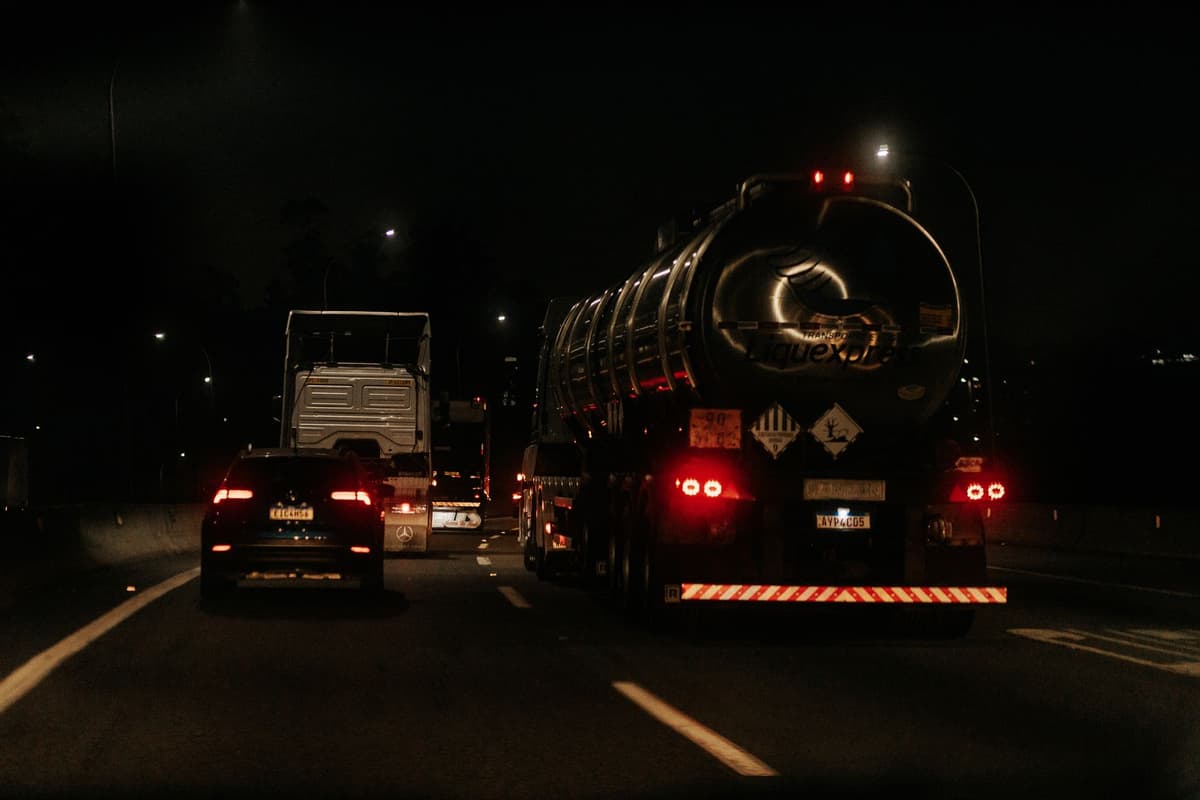
Photo by Anderson Martins on Pexels
The Reclaiming of the Inner City
The most profound impact of self-powered logistics will not be felt on the open highway, but at the city limits. Currently, the "last mile" of delivery is an environmental and spatial disaster. Heavy class-8 trucks squeeze into historic city centers designed for horse-drawn carriages, blocking lanes, destroying curbs, and idling in traffic.
With self-powered trailer technology, the concept of the "last mile" dissolves into a continuous, modular flow. A large road-train of coupled trailers can disassemble itself at an urban perimeter staging yard. From there, individual, smaller pods can navigate city streets quietly, using precise electric drive systems that emit zero localized emissions and produce minimal noise.
This transition allows urban planners to rethink street design entirely. If freight delivery can be restricted to quiet, low-profile, autonomous pods operating during off-peak night hours, we can reclaim valuable daytime road space for pedestrians, transit lanes, and green infrastructure. The noisy, hazardous loading zones that currently scar our streetscapes could be phased out entirely.
What This Actually Means
We must stop viewing autonomous transportation through the narrow lens of passenger vehicles and robo-taxis. The real revolution is happening in the unglamorous world of freight, and it is happening from the back of the vehicle forward. The self-powered trailer is the Trojan horse of autonomous logistics, quietly solving the hardest problems of self-driving technology while the world watches consumer vehicles.
This shift demands an immediate response from urban planners and zoning boards. If we continue to build warehouses and highways based on the assumptions of 1950s trucking, we will lock ourselves into obsolete, carbon-intensive infrastructure. We must begin designing modular logistics interfaces now, before these intelligent pods arrive at our city gates looking for a place to dock.
Ultimately, the decoupling of the trailer from the tractor is the decoupling of freight from human scale. It is the beginning of an era where cargo behaves more like data packet routing on the internet—fluid, automated, and invisible. The cities that adapt to this fluid flow of goods will thrive; those that cling to the asphalt-heavy models of the past will find themselves choked by their own supply chains.
Quick Answers
How do self-powered trailers actually save fuel?
They use regenerative braking to capture energy during deceleration and store it in onboard batteries, which then power electric hub motors to assist the primary tractor during acceleration and hill climbs, reducing the load on the diesel engine.
Will these autonomous trailers require new highways?
No, they are designed to run on existing interstate infrastructure, but their deployment will require significant upgrades to bridge weight limits, charging stations, and highway lane markings to ensure safe autonomous operation.
When will we see fully autonomous cargo pods on city streets?
While highway testing is already underway, fully autonomous, cab-less cargo pods operating in complex urban environments are likely a decade away, pending regulatory approval and the construction of peripheral transfer hubs.