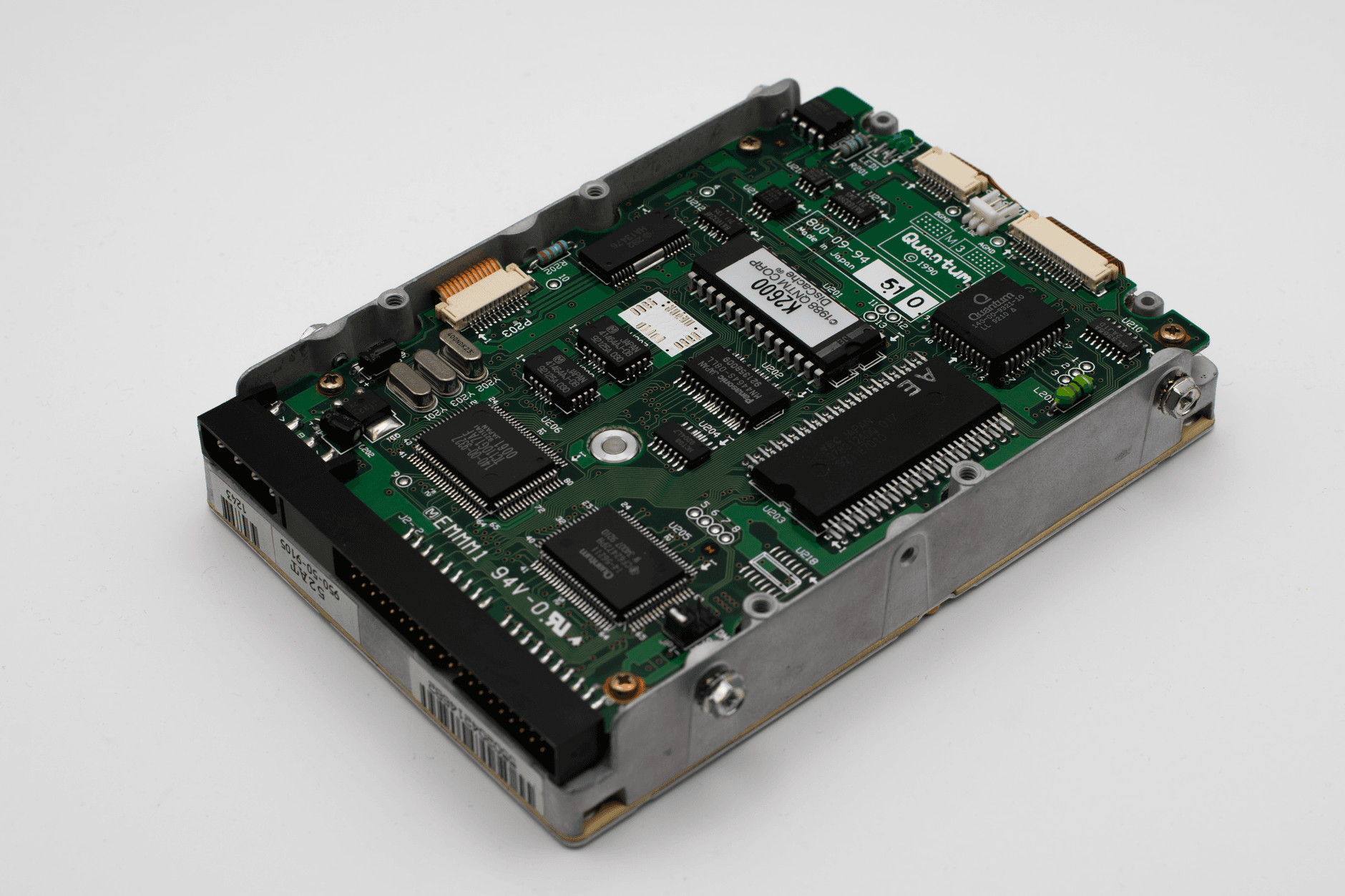
We have spent the last seven decades treating computer processors like Victorian boarding school headmasters. We demand absolute, unyielding discipline. A one must be a one. A zero must be a zero. If a single copper pathway gets a little too warm and whispers a fraction of a doubt, we throw a tantrum, liquid-cool the entire rig with glowing blue fluid, and demand perfection.
But some researchers have finally looked at the electric bill for our collective neurosis and decided on a different path. They have built the world's largest "probabilistic computer," a machine that doesn't fight thermal noise. Instead, it pulls up a chair, pours the noise a drink, and asks it to do the math. It turns out that if you stop trying to force silicon to be sober, it can solve incredibly complex problems in a fraction of the time.
The Overmedicated World of Binary Logic
To understand why this is hilarious, you have to understand how stupidly hard we work to keep normal computers quiet. In a standard microchip, heat is the enemy. Heat is molecular chaos. It makes electrons jump over fences they shouldn't be jumping, causing "bit flips" that make your Excel spreadsheet crash or your video game character clip through the floor.
We spend billions of dollars trying to freeze this chaos out. Quantum computers are the worst offenders, requiring dilution refrigerators that chill processors down to 0.015 Kelvin. That is colder than deep space, all so a fragile qubit doesn't get startled by a passing photon and forget its calculations. It is the technological equivalent of needing a sensory deprivation tank just to balance your checkbook.
Thermodynamic computing looks at this shivering, pampered setup and laughs. Researchers from places like Japan's Tohoku University are using the natural, chaotic shaking of heated materials to generate random states. They are using the physical panic of hot atoms as a feature, not a bug.
Solving the Traveling Salesman with Shaky Hands
Imagine you are a traveling salesman who needs to visit 40 different cities in the most efficient order. To find the absolute best route using a traditional computer, the machine has to calculate every single possible combination one by one. It is a mathematical nightmare that would take a standard laptop longer than the remaining lifespan of the universe to solve.

Photo by Andrea Piacquadio on Pexels
A probabilistic computer solves this by essentially throwing a handful of glitter at a map and seeing where it lands. Because the internal components are constantly fluctuating due to thermal noise, they naturally drift toward the lowest energy state. In physics, the lowest energy state is the most stable one. In mathematics, that state happens to represent the optimal solution to your problem.
Instead of calculating every path, the computer just lets its own internal chaos settle into the easiest shape. It is like trying to find the lowest point in a bumpy valley by dropping a marble and letting gravity do the work, rather than mapping every square inch of the terrain with a ruler. It is lazy, it is chaotic, and it is brilliant.
The Glory of Being Close Enough
We have become obsessed with exactness, even when we do not need it. If you are training an AI to recognize a dog, the computer does not need to calculate the exact molecular weight of a golden retriever's left ear to 15 decimal places. It just needs to know if the thing has a wet nose and wags its tail.
Traditional computers waste massive amounts of power being precise about things that do not require precision. A thermodynamic computer is comfortable with ambiguity. It gives you an answer that is 99.9% correct in three milliseconds, using the same amount of electricity it takes to power a pocket flashlight.
This is not just a theory anymore. Researchers recently built a system using 30,000 probabilistic bits (or p-bits) that can handle complex optimization problems without sweating. While IBM is busy building giant, gold-plated chandeliers that look like steampunk turnip lanterns just to keep their quantum chips cold, the thermodynamic crowd is running circles around them using hardware that runs just fine at the temperature of a lukewarm cup of tea.
What This Actually Means
We are approaching the physical limits of traditional silicon. We cannot make transistors much smaller without electrons literally teleporting through the barriers because of quantum tunneling. Our current path of just "making things smaller and cooling them down more" is hitting a brick wall made of basic physics.
Thermodynamic computing is a glorious, white-flag-waving surrender to the universe. It is an admission that nature is much better at solving complex, chaotic systems than we are, mostly because nature has been doing it for 13.8 billion years without once needing to install a software update.
By embracing the noise, we might finally get computers that can simulate molecular structures, optimize global supply chains, and train massive neural networks without needing to build a dedicated nuclear power plant next to the server farm. We just have to get comfortable with the idea that our machines are going to be a little bit shaky, a little bit sweaty, and occasionally just winging it.
Quick Answers
Is my next gaming PC going to be thermodynamic?
No. If you tried to play a first-person shooter on a probabilistic computer, your gun would occasionally turn into a bouquet of flowers because the hardware got a little too warm and guessed wrong.
Do these computers really run on heat?
They run on the electrical noise caused by heat. They still need a power source, but they use the natural, chaotic jiggling of atoms to do the heavy lifting of random number generation instead of forcing transistors to simulate randomness.
Is this better than quantum computing?
For certain optimization problems, yes, because you do not need a multi-million-dollar refrigerator to run it. It works at room temperature, which makes it infinitely more practical for actual deployment in real-world data centers.