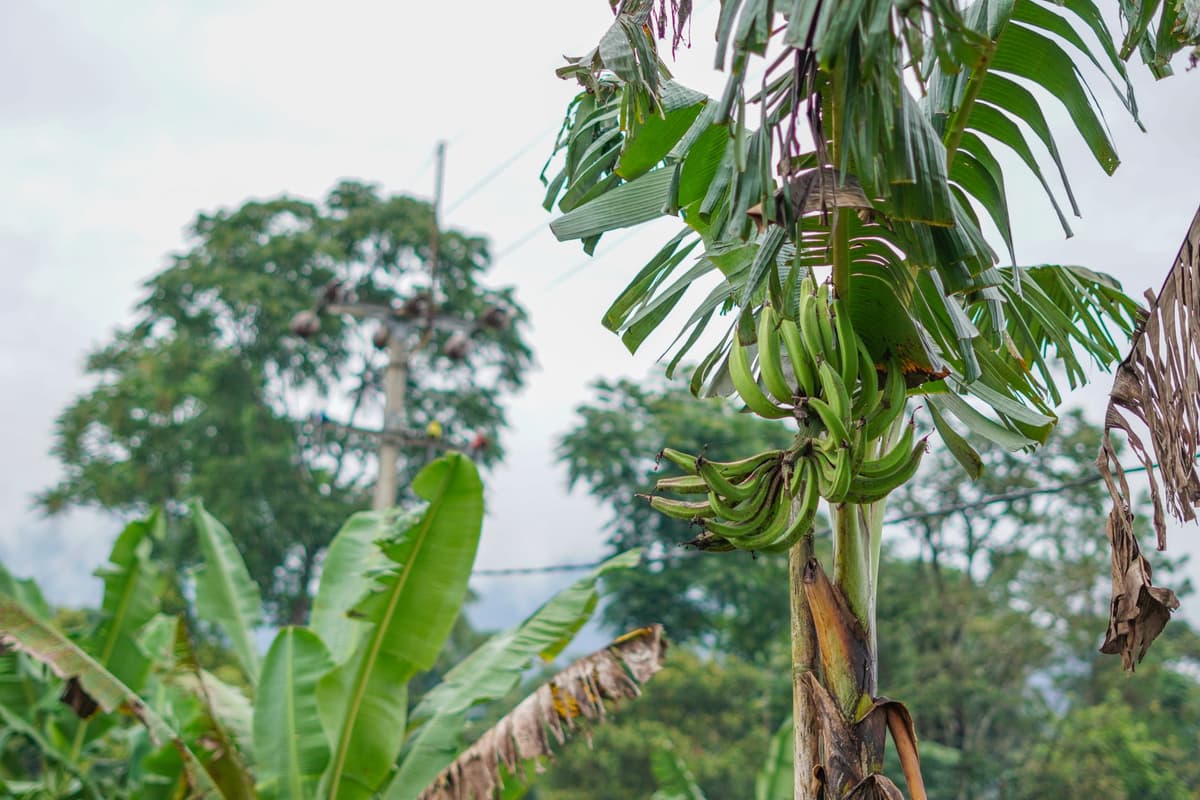
The fruiting of a Musa basjoo in Rayleigh, Essex, is being framed by local media as a botanical curiosity, a bit of tropical flair in a typically temperate landscape. This is a mistake. When a plant that requires consistent warmth and a long, frost-free growing season suddenly produces fruit after fifteen years of sterile leaves, it isn't 'finding a way' to survive. It is reacting to a baseline shift in the environment that has finally crossed a critical physiological threshold. We are witnessing the real-time rewriting of the Royal Horticultural Society’s hardiness zones, and the implications go far beyond the novelty of homegrown fruit.
For over a decade, this specific plant in Rayleigh stood as a decorative outlier, surviving the winters but never possessing the accumulated thermal energy required to trigger reproduction. In 2024, that changed. This isn't an isolated incident; it is a data point in a broader trend where the 'A' and 'B' classifications of climate zones are migrating north at a rate that traditional agricultural policy is struggling to track. The backyard has become the most accurate laboratory we have for measuring micro-climate volatility.
The Physiological Tipping Point
Plants are binary systems when it comes to reproduction. They either have the required Growing Degree Days (GDD) to fruit, or they do not. The fact that this Essex banana tree has finally transitioned from vegetative growth to reproductive success indicates that the local 'thermal sum'—the accumulated heat over the growing season—has hit a level previously reserved for the Mediterranean. In the UK, the average temperature has already risen by about 1.1°C compared to the 1961–1990 average. While a single degree sounds negligible to a human, to a tropical plant, it is the difference between life and dormancy.
This shift isn't just about the heat of the summer; it is about the softening of the winter. The UK’s 10 warmest years on record have all occurred since 2002. For a banana plant to fruit, the pseudo-stem must survive the winter without being killed back to the ground by a hard frost. When we see fruit in Rayleigh, we are seeing proof that the 'killing frosts' which once defined British winters are becoming intermittent or localized to the point of irrelevance for hardy tropicals.
The Failure of Traditional Mapping
We currently rely on static maps to tell us what will grow where, but these maps are becoming historical artifacts rather than predictive tools. The USDA hardiness zones and their European equivalents were designed for a world of climate stability. They assume that the past fifty years of weather are a reliable guide for the next ten. The Rayleigh banana proves that these zones are now fluid. We are seeing a 'Mediterraneanization' of the South East of England that is moving faster than our institutional ability to record it.
This movement creates a dangerous disconnect. While gardeners are successfully experimenting with citrus, olives, and bananas, our large-scale agricultural systems remain anchored to crops that may soon be ill-suited for the shifting soil temperatures and water availability of the region. If the thermal profile of Essex now supports tropical fruiting, the cooling requirements for traditional UK orchard fruits like Bramley apples—which need a specific number of 'chill hours' to set fruit—are under immediate threat. We are gaining the exotic at the expense of the essential.
Backyard Bio-Indicators as Data
There is a specific kind of high-resolution data that a network of private gardens provides which a central weather station cannot. A weather station measures ambient air temperature in a controlled box; a garden measures the total environmental impact on biology. This is 'community-sourced phenology.' When thousands of gardeners report that their plants are blooming three weeks early or fruiting for the first time in two decades, they are documenting the jagged edges of climate change.
This biological data reveals the emergence of urban heat islands and protected micro-climates that allow species to thrive far outside their traditional ranges. However, this isn't a success story for biodiversity. It is an indicator of displacement. As the thermal niche for a banana plant opens up in the UK, the niche for native species—insects, birds, and flora that evolved for a temperate, predictable cycle—is collapsing. The Rayleigh banana is a colonizer made possible by an atmosphere in flux.
What This Actually Means
The fruiting of tropical plants in Northern Europe should be viewed with clinical concern rather than horticultural pride. It is a visual confirmation that the climate is no longer merely 'warming' in an abstract sense; it is structurally transforming. We are losing the seasonal guardrails that have defined European agriculture for a millennium. If the UK's hardiness zones continue to shift at this pace, the very concept of a 'native' landscape will be obsolete by the end of the century.
We need to stop treating these events as quirky human-interest stories. They are biological evidence of a massive energy imbalance in our atmosphere. The banana in Rayleigh is not an achievement of the gardener; it is an achievement of a warming planet that is no longer behaving according to the rules we wrote for it. We are trading our predictable, temperate stability for a volatile, tropical uncertainty, and the cost of that trade remains unknown.
Quick Answers
Does this mean the UK can start commercial banana farming?
No. While individual plants in protected micro-climates may fruit, the UK lacks the consistent humidity, light intensity, and year-round heat required for viable commercial yields.
Is this just a result of a particularly hot summer?
It is the result of a cumulative trend. Fruiting requires the pseudo-stem to survive multiple winters and accumulate enough thermal energy over several seasons, indicating a long-term shift, not just one heatwave.
Why is this considered a 'bio-indicator'?
Plants act as living sensors that integrate multiple factors—temperature, frost frequency, and season length—into a single visible outcome: the fruit. They tell us more about the environment's state than a simple thermometer reading.