
We have treated the upper atmosphere the same way we treated the oceans in the nineteenth century: as an infinite sink, incapable of saturation and immune to permanent damage. That illusion is about to shatter. SpaceX’s proposal to scale its Starlink network to over 100,000 satellites represents a tipping point where orbital density ceases to be a traffic management problem and becomes a global ecological crisis.
This is no longer about dodging space junk. At this scale, we are talking about the literal alteration of the ionosphere and the creation of an artificial electromagnetic shield around the planet. The sheer volume of metal, signals, and chemical exhaust promised by this expansion will fundamentally disconnect ground-based humanity from the rest of the universe.
The Plasma Shield We Didn't Ask For
When we talk about 100,000 satellites, we are talking about a continuous, self-replacing mesh of electronics orbiting just a few hundred kilometers above our heads. Every single one of these satellites has a lifespan of roughly five years. To maintain a fleet of this size, operators will have to launch and deorbit dozens of satellites every single day, turning our upper atmosphere into a permanent incinerator for high-tech metals.
Scientists estimate that the vaporized aluminum from re-entering satellites could soon deposit more metallic ash into the stratosphere than natural meteoroids do. This metallic dust doesn't just disappear. It drifts in the ionosphere, where it can conduct electricity and potentially deplete the ozone layer or alter the Earth’s magnetic field.
We are effectively wrapping the planet in a thin, highly reflective metallic haze. This is not a hypothetical sci-fi scenario; it is basic physics. By filling the sky with conductive debris and constant high-frequency transmissions, we risk creating a permanent reflectivity shell that alters the planet's natural electromagnetic signature.
The Death of Radio Astronomy
For nearly a century, radio astronomy has allowed us to peer into the darkest corners of the universe, detecting the faint whispers of the Big Bang and mapping distant galaxies. These signals are incredibly delicate. The energy collected by all radio telescopes since the inception of the field is less than the energy of a single falling snowflake.
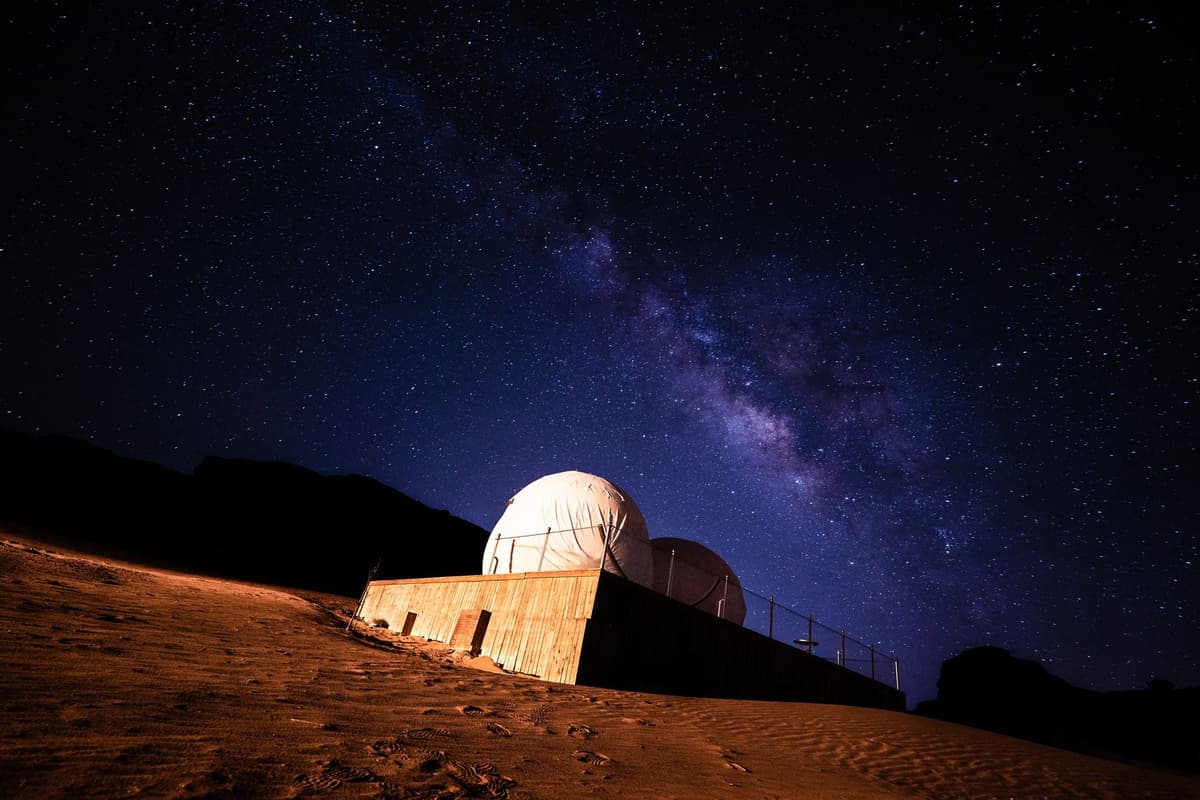
Photo by Emran Omar on Pexels
Now, imagine trying to hear those whispers while standing next to a stadium PA system. That is what 100,000 satellites transmitting high-bandwidth data down to Earth will do. The leaked radiation from these megaconstellations will blind our most sensitive instruments, rendering billions of dollars of scientific infrastructure useless.
It is a classic tragedy of the commons. One private company secures the short-term financial benefit of global broadband, while the global scientific community loses its ability to study the universe. Once these frequencies are saturated, there is no going back. We cannot simply filter out the noise of 100,000 active transmitters.
Sovereignty and the New Enclosure Movement
This rapid expansion is occurring in a regulatory vacuum. The Federal Communications Commission (FCC) in the United States routinely grants licenses for these massive launches without comprehensive environmental reviews, treating space as if it exists outside the global ecosystem.
This is a modern iteration of the enclosure movement, where public lands were fenced off for private profit. In this case, the sky itself is being enclosed. A single corporation, operating under the jurisdiction of a single nation, is unilaterally deciding the future of a global resource that belongs to all of humanity.
- The Outer Space Treaty of 1967 states that space exploration should be carried out for the benefit of all countries.
- Current unilateral licensing bypassed international consensus entirely.
- No mechanism exists to force a private company to clean up the molecular ash left in the stratosphere.
By the time international bodies agree on how to regulate orbital carrying capacity, the sky will already be occupied. The physical reality of 100,000 objects in low Earth orbit will dictate the rules, leaving the rest of the world to adapt to a reality they never voted for.
What This Actually Means
We are on the verge of losing something profound: an unobstructed view of the cosmos. For the entirety of human history, the night sky has been a source of science, philosophy, and collective wonder. To trade that away for marginally faster internet speeds and higher corporate valuation is a historically short-sighted bargain.
If we proceed down this path without immediate, binding international limits on orbital density, we will seal ourselves inside a cage of our own making. Ground-based astronomy will become a relic of the past, replaced by space-based telescopes that only the wealthiest nations and corporations can afford to build and launch.
This is not progress; it is a retreat. We are building a roof over our heads and calling it a ceiling of opportunity.
Quick Answers
Why can't astronomers just use space telescopes like James Webb?
Space telescopes are incredibly expensive, have limited lifespans, and cannot be easily repaired. Ground-based observatories are essential because they can host massive, upgradable instruments that run continuously for decades.
How does satellite re-entry affect the atmosphere?
When satellites burn up upon re-entry, they leave behind oxidized aluminum nanoparticles. These particles can remain suspended in the stratosphere for decades, potentially damaging the ozone layer and altering how the atmosphere reflects solar radiation.
Isn't global internet access worth this sacrifice?
Connecting underserved areas is vital, but megaconstellations are not the only solution. Fiber-optic cables, high-altitude balloons, and targeted terrestrial networks can provide access without permanently compromising the global commons of orbit.