
Your Internal Organs Are Not Fans Of Your Weekend Benders
For decades, the medical establishment has been wagging its finger at us like a disappointed librarian, demanding we get eight hours of sleep. It was the magic number, the holy grail, the golden ticket to not looking like a dehydrated raisin by age forty. But a massive study involving over 60,000 participants in the UK Biobank has essentially flipped the table on that advice. It turns out that sleep regularity—going to bed and waking up at the same time—is a 20% to 48% stronger predictor of all-cause mortality than how long you actually spend drooling on your pillow.
Imagine your body is a high-end restaurant. If the chef knows the dinner rush starts at 7:00 PM, he can prep the scallops and yell at the sous-chef in an orderly fashion. But if you show up at 3:00 AM demanding a souffle, the kitchen staff is going to riot, the oven won't be preheated, and someone is probably getting stabbed with a paring knife. That is your liver when you decide to 'catch up' on sleep by staying in bed until noon on a Sunday. Your liver was ready to process toxins at 8:00 AM, and you stood it up like a bad Tinder date.
We have spent years obsessing over the quantity of our sleep while completely ignoring the schedule, treating our circadian rhythms like a suggestion rather than a biological mandate. You can’t just bank hours like a corrupt politician banks favors. If you sleep four hours one night and twelve the next, your mitochondria are sitting there in the dark, confused and crying, wondering if the sun has been permanently extinguished by a cosmic anomaly.
The Circadian Rhythm Is A Drunk Conductor
Every cell in your body has a clock. This isn't a metaphor; it's a terrifying reality of biological micromanagement. When these clocks are in sync, you are a localized miracle of efficiency. When they aren't, you are essentially a bag of wet garbage held together by caffeine and spite. The shift toward 'Circadian Rhythm Stability' means doctors are finally realizing that 'social jetlag'—the shift in sleep timing between work days and free days—is actively killing us faster than the actual lack of sleep.
A chaotic schedule creates a state of perpetual physiological whiplash. Your heart expects a certain blood pressure drop at midnight. Your gut expects a metabolic slowdown. When you decide to stay up until 2:00 AM watching 'is it cake?' videos on YouTube, you are effectively gaslighting your own pancreas. It’s asking for instructions, and you’re giving it a confusing mix of blue light and dopamine. By the time your body figures out what time it is, you’ve already hit the snooze button four times and started the cycle of chaos all over again.
- Your brain hates surprises, especially regarding when it gets to turn off.
- Consistency reduces systemic inflammation, which is basically your body’s way of saying 'I'm annoyed.'
- A regular 6-hour sleeper is statistically more likely to outlive a 'sometimes 4, sometimes 10' sleeper.
Why Your 'Catch-Up' Sleep Is A Filthy Lie
The idea that you can 'make up' for a week of late nights by sleeping until 2:00 PM on Saturday is the greatest scientific myth since the food pyramid told us to eat eleven servings of bread a day. You aren't catching up; you're just moving the goalposts while the game is still being played. This behavior actually exacerbates the risk of cardiovascular issues and metabolic syndrome because your body never knows which version of the day it's supposed to be preparing for.

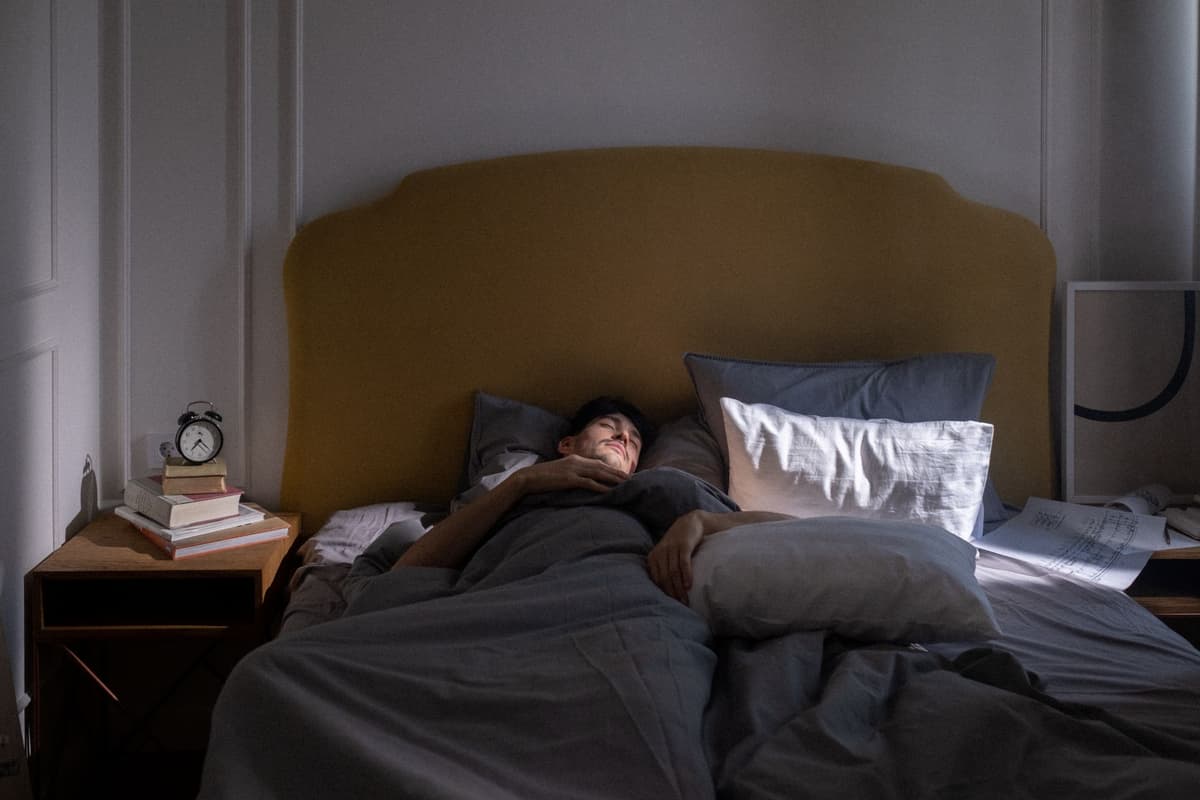
Photo by Mikhail Nilov on Pexels
Think of it as a corporate headquarters where the CEO (your brain) keeps changing the start time of the morning meeting. On Monday, it’s 9:00 AM. On Tuesday, it’s 11:30 AM. By Friday, the CEO shows up at 4:00 PM in a bathrobe screaming about synergy. The employees (your organs) have checked out. They aren't doing their jobs; they're just browsing the internal equivalent of LinkedIn looking for a way out of this nightmare. Consistency is the only thing that keeps the staff from quitting.
We need to stop bragging about 'getting our eight hours' if we got them through a series of erratic, unplanned collapses. It’s better to be a boring person who goes to bed at 11:00 PM every single night than a 'sleep warrior' who fluctuates between insomnia and hibernation. Your body craves the mundane. It wants to know exactly when the lights are going out so it can start the internal janitorial shift without being interrupted by a 1:00 AM burrito.
What This Actually Means
This shift in focus means we need to stop looking at our fitness trackers for a total number and start looking at the gaps. If your sleep graph looks like a heart rate monitor during a horror movie, you’re doing it wrong. The 'Consistency over Quantity' paradigm is a call to embrace the routine of a 1950s sitcom dad. Go to bed. Wake up. Repeat until death—which, according to this data, will now happen much later than previously expected.
Ultimately, your biological systems are built on predictability. We evolved under a sun that, generally speaking, followed a pretty strict itinerary. Our modern ability to ignore the sun with the help of LED bulbs and Netflix has given us the illusion of freedom, but our DNA is still stuck in the Pleistocene. You can’t negotiate with your genes. They want the same thing every day, and if they don't get it, they start breaking things.
So, if you want to live longer, stop worrying about that one night you stayed up late and start worrying about the fact that your bedtime varies by three hours every weekend. Pick a time, stick to it, and treat that schedule like a sacred text. Your heart, your liver, and your surprisingly judgmental pancreas will thank you for the boredom.
Quick Answers
Does this mean I can sleep five hours a night if I'm consistent?
Technically, you'll be more stable than a chaotic eight-hour sleeper, but you'll still be a very tired, very consistent zombie.
What if I have one 'wild' night a week?
Your body can handle a one-off error, but if 'wild' means shifting your wake-up time by four hours, you're essentially giving yourself jetlag without the benefit of a vacation.
Is there a 'best' time to go to bed?
Science suggests the specific hour matters less than the repetition, though your body generally prefers you don't fight the natural sunset by more than a few hours.
Can I fix my rhythm if it's already ruined?
Yes, but it requires the discipline of a monk; start by waking up at the same time every day, even if you spent the night staring at the ceiling.