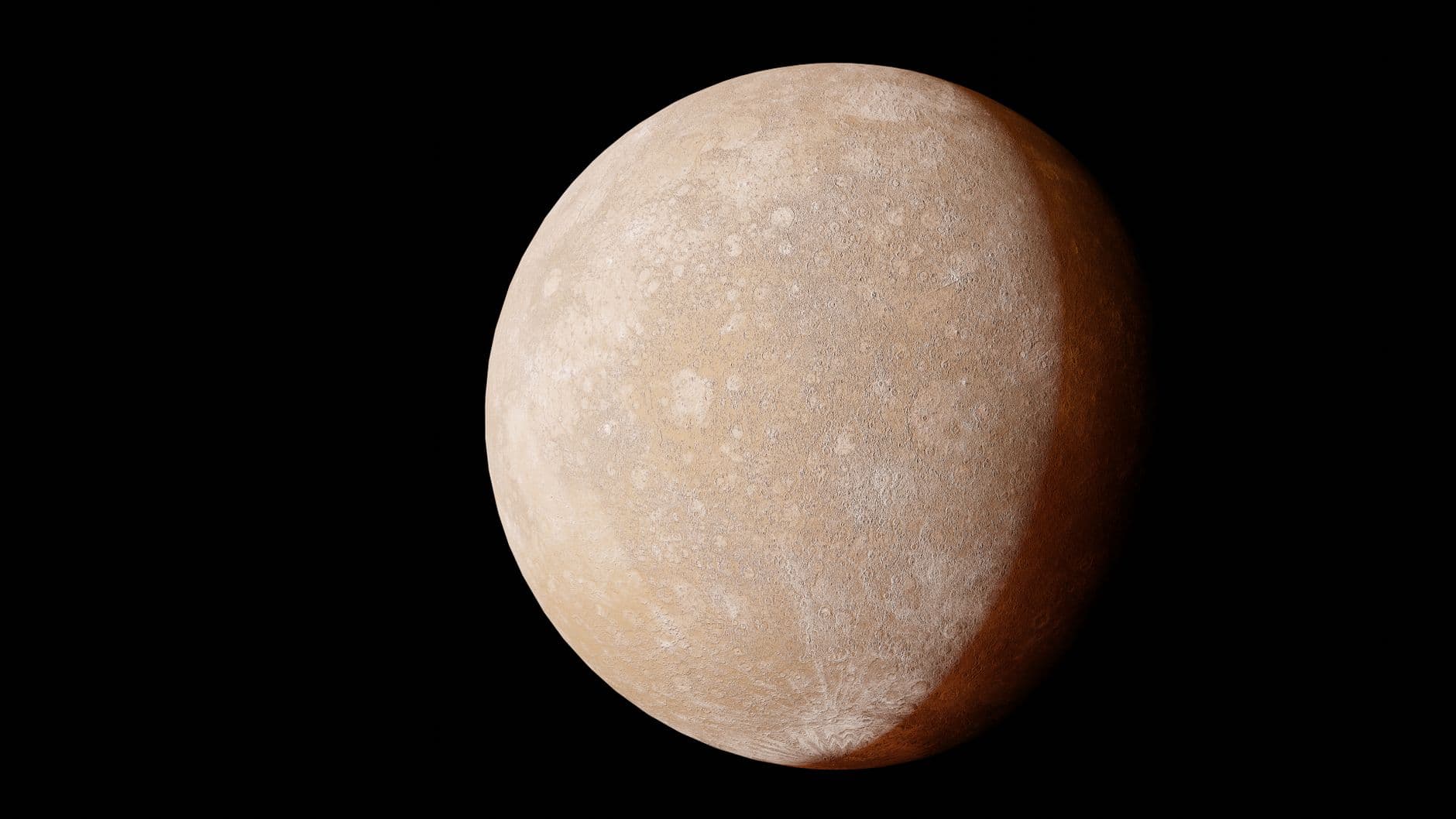
The Universe Just Handed Us a Heavy Metal Rock
For years, we’ve been peering into the deep dark like a kid staring at a blurry ant farm, hoping to see something besides hydrogen-huffing gas giants. Most planets we find are either boring gas bags or scorched rocks that look like they’ve been through a cosmic deep-fryer. Then comes GJ 9827 d, a planet that decided to stop being basic and actually develop a personality—specifically, an atmosphere rich in heavier molecules rather than just the light, fluffy hydrogen leftovers from its birth.
Think of a primary atmosphere like the awkward peach fuzz a teenager grows; it’s just there because of biology and it’s usually embarrassing. A secondary atmosphere is the full, groomed beard of the planetary world. It means the planet is doing something. It’s cooking. It’s venting gases from its interior like a grumpy landlord complaining about the pipes. This is the first time we’ve seen a planet this small (about twice the size of Earth) holding onto its air like a hoarder with a stack of 1994 National Geographics.
Finding this atmosphere is like walking into a dive bar at 3 AM and realizing the guy in the corner isn't just a pile of laundry, but an actual human being with a pulse and a LinkedIn profile. It shifts the entire search for life from 'Look at that big ball of farts' to 'Wait, is that planet actually breathing?'
Geology is Just Volcanic Burping
To have a secondary atmosphere, a planet needs to have some guts. Specifically, it needs active geology. You can’t just sit there like a dead lump of coal and expect to have a nice gas envelope. You have to earn it through billions of years of volcanic tantrums and tectonic shifting. GJ 9827 d is basically out there sweating out heavy elements, proving that it has an internal heat source that hasn't quit yet.
Photo by Hồng Quang Official on Pexels
When a planet is born, it’s surrounded by a cloud of hydrogen and helium. If it’s small and close to its star, that star usually acts like a cosmic leaf blower and blasts that light gas into the next zip code. For a planet to have an atmosphere after that, it has to manufacture a new one from the inside out. It’s planetary recycling. It’s the ultimate DIY project, except instead of a birdhouse, you’re building a shield against the soul-crushing vacuum of space.
This matters because complex life is high-maintenance. You can't evolve a nervous system if your home world is being sandblasted by solar radiation every Tuesday. You need the stability of a secondary atmosphere to keep the temperature from swinging wildly between 'absolute zero' and 'surface of a panini press.' GJ 9827 d is effectively telling us that the 'Habitable Zone' isn't just a distance on a map; it’s a commitment to internal plumbing.
Why We Care About 6,000 Degree Steam
Now, don't pack your bags just yet. GJ 9827 d is about 800 degrees Fahrenheit. It’s not exactly a Caribbean vacation; it’s more like being trapped inside a self-cleaning oven that’s also a pressure cooker. Astronomers think the atmosphere might be mostly water vapor. Imagine a sauna, but the sauna is the size of a world and the steam is hot enough to melt your face into a puddle of regret.

Photo by Lucas George Wendt on Pexels
But here’s the kicker: if a planet that hot can hold onto a secondary atmosphere, then cooler, Earth-sized planets in the same neighborhood probably can too. We’ve been looking for 'Earth 2.0' by trying to find planets that look exactly like us, which is like trying to find a soulmate by only looking for people who wear the same specific brand of orthopedic shoes. GJ 9827 d shows us that the universe has a much wider wardrobe than we thought.
We are currently using the James Webb Space Telescope (JWST) to sniff these planets out. It’s essentially a $10 billion nose floating in space. Before this, we were just guessing if these rocks had air. Now we have proof that the 'Secondary Atmosphere' frontier is real. We’re no longer just looking for rocks; we’re looking for rocks with character. Rocks that burp. Rocks that have something to say.
What This Actually Means
This discovery is the death knell for the idea that rocky planets are rare or inherently dead. If GJ 9827 d can manage to build itself a second skin while being cooked by its star, the universe is likely crawling with planets that have managed to do the same in much friendlier conditions. We are moving from the 'Is there anything out there?' phase to the 'What exactly is that thing doing?' phase.
It means our models of planetary evolution were actually a bit too pessimistic. We thought stars were bullies that stripped every small planet naked. It turns out some planets are just too stubborn to stay that way. They fight back with volcanoes and gas. They insist on existing in a way that makes the universe more interesting and complicated.
Ultimately, GJ 9827 d is a beacon of hope for every lonely nerd staring at the stars. It’s proof that the ingredients for a complex, stable environment aren't just limited to our little blue marble. The universe is messy, volcanic, and full of hot steam—which, if you’ve ever been to a family Thanksgiving, feels surprisingly like home.
Quick Answers
Can I breathe the air on GJ 9827 d?
Only if you enjoy inhaling 800-degree steam and having your lungs instantly turned into a very sad dim sum. So, no.
Is there an ocean on this planet?
Probably not a liquid one you'd recognize, unless you consider a 'supercritical fluid' that behaves like both a gas and a liquid to be a good swimming spot. It’s more of a global pressure-cooker than a beach.
Why is it called a 'secondary' atmosphere?
Because the 'primary' one (the original hydrogen/helium mix) got blown away by the star, and the planet had to grow a new one from volcanic gases, like a lizard regrowing a tail made of carbon dioxide and water vapor.